
Sabalenka vs Kyrgios: “Battle of the Sexes” 2025 — Showmanship or a Step Back?
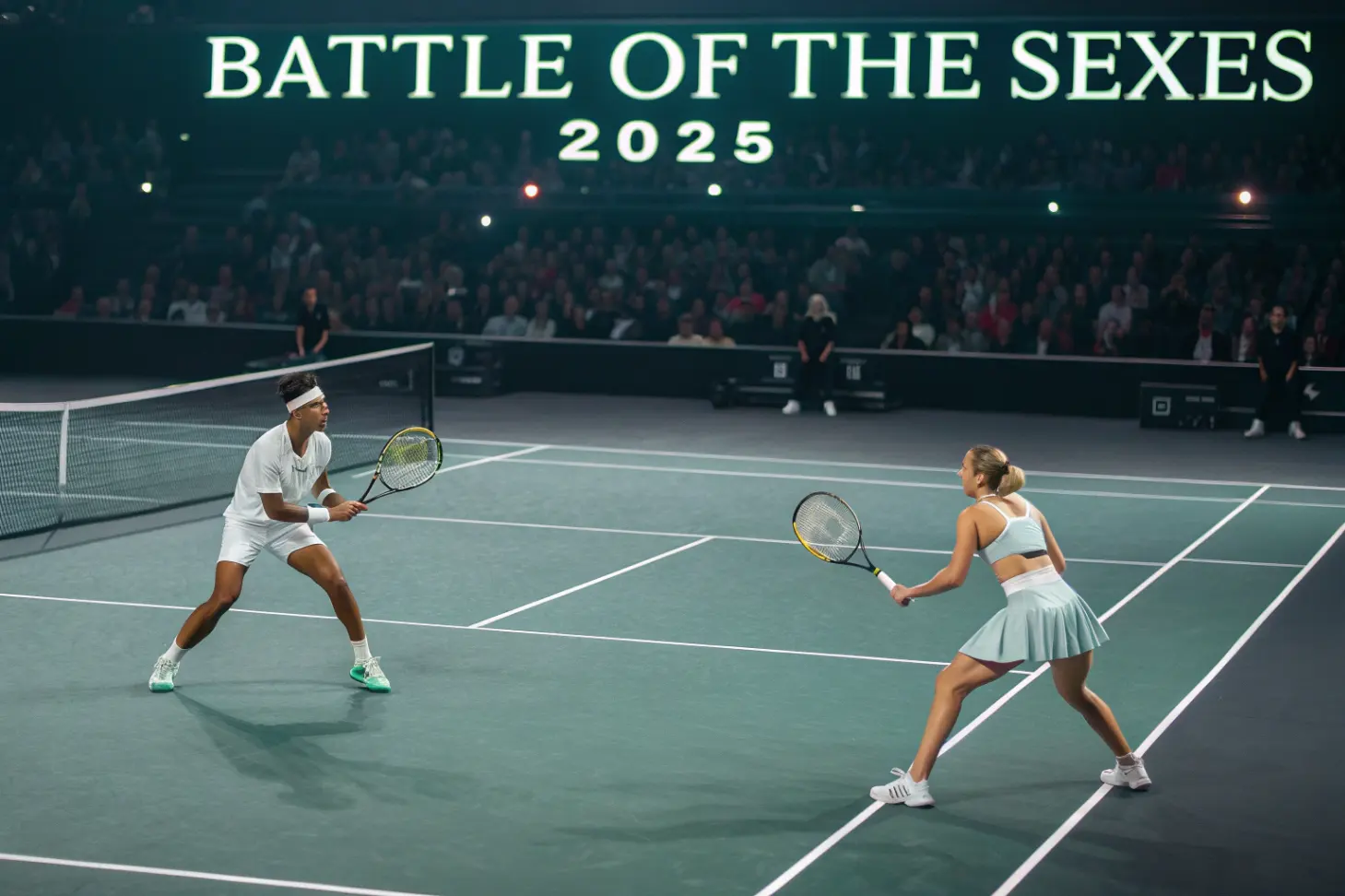
The announcement of a possible Aryna Sabalenka vs Nick Kyrgios “Battle of the Sexes” exhibition match in 2025 instantly ignited debate across the tennis world. For some fans, it sounds like irresistible entertainment: two of the most explosive personalities in modern tennis, unlimited power, trash talk, packed stands, and viral clips guaranteed. For others, it raises uncomfortable questions about gender equality, sporting integrity, and whether tennis should be revisiting concepts that feel borrowed from another era.
This hypothetical clash sits at the intersection of sport, spectacle, media economics, and cultural symbolism. It is not just about who would win a match played under exhibition rules, but about what such an event would represent in 2025. Would it help modern tennis grow, or would it undermine decades of progress toward treating men’s and women’s tennis as equally legitimate, compelling, and commercially valuable?
To answer that, we need to look beyond the headlines and dig into context, history, playing styles, marketing incentives, and the broader cultural moment tennis currently occupies.
Why Sabalenka vs Kyrgios Became a Viral Tennis Topic
The idea of Sabalenka vs Kyrgios did not emerge in a vacuum. Both players are among the most discussed figures in the sport, not only for their results but for their personalities. Sabalenka embodies the modern power-based women’s game: relentless aggression, thunderous groundstrokes, emotional intensity, and a willingness to dominate rallies rather than construct them patiently. Kyrgios, meanwhile, has built his brand around unpredictability, raw talent, serve-dominated tennis, and open defiance of tennis tradition.
In an era driven by social media engagement, these are precisely the profiles promoters crave. A Sabalenka vs Kyrgios exhibition promises drama before a ball is even struck. Clips would circulate instantly, debates would rage across platforms, and casual sports fans who rarely watch full tennis matches would tune in simply to see what happens.
There is also a broader commercial backdrop. Tennis faces increasing competition for attention from faster, more digestible sports content. Exhibitions, team formats, and hybrid events have multiplied as organizers look for new ways to package the game. Against this background, a “Battle of the Sexes” concept feels like an easy hook: instantly recognizable, historically loaded, and emotionally charged.
At the same time, the phrase itself triggers skepticism. “Battle of the Sexes” is not a neutral label. It carries cultural baggage that complicates its use in a modern sporting environment increasingly focused on equality, respect, and professionalism.
A Brief History of “Battle of the Sexes” in Tennis
Before evaluating a 2025 version, it is essential to understand where the concept comes from and why it still resonates.
The most famous “Battle of the Sexes” match remains the 1973 encounter between Billie Jean King and Bobby Riggs. That match was not merely an exhibition; it was a cultural moment. King’s victory carried enormous symbolic weight at a time when women’s sports were routinely dismissed, underfunded, and ridiculed. It helped legitimize women’s tennis and accelerated momentum toward equal prize money.
Since then, various mixed-gender exhibitions have appeared, but few carried the same stakes or social impact. Most were novelty events designed primarily for entertainment. Over time, as women’s tennis grew into a powerful commercial product in its own right, the need for such symbolic confrontations diminished.
The key difference in 2025 is context. Women’s tennis no longer needs validation through comparison with men’s tennis. Players like Serena Williams, Iga Świątek, and Aryna Sabalenka have proven that women’s matches can be just as compelling, intense, and commercially successful as men’s. This changes how a modern “Battle of the Sexes” would be interpreted.
To illustrate how the concept has evolved, consider the following comparison of historical and modern contexts.
| Era | Purpose of the Match | Cultural Meaning | Public Perception |
|---|---|---|---|
| 1970s | Prove women can compete | Gender equality statement | Serious social milestone |
| 1990s–2000s | Exhibition novelty | Entertainment-focused | Lighthearted curiosity |
| 2020s | Marketing and spectacle | Potentially controversial | Divided opinions |
This evolution matters because what once felt revolutionary can now feel redundant or even regressive if not handled carefully. A Sabalenka vs Kyrgios match would inevitably be judged against this historical backdrop, whether organizers intend it or not.
Playing Styles and the Illusion of a Fair Match
On paper, Sabalenka vs Kyrgios seems intriguing because both rely heavily on power. But this superficial similarity can be misleading. Men’s and women’s tennis differ not just in strength but in speed, serve dynamics, court coverage, and rally patterns.
A key issue with any mixed-gender exhibition is rule selection. Court size, serve speed limits, scoring formats, and equipment choices all shape how “fair” the contest appears. Without careful balancing, the match risks becoming either uncompetitive or artificially constrained.
Several factors complicate the idea of genuine sporting balance:
- Serve dominance, which disproportionately favors the male player.
- Reaction time differences at higher ball speeds.
- Tactical adjustments required under modified rules.
- Physical endurance across longer exchanges.
Each of these elements forces organizers to intervene, turning the match into a constructed spectacle rather than a pure competition. While that may be acceptable for entertainment, it weakens any claim that the result proves something meaningful about gender parity in tennis.
The danger lies in perception. If Kyrgios were to win easily, critics would argue that it reinforces outdated stereotypes. If Sabalenka were to win under heavily modified rules, skeptics would dismiss the result as artificial. Either way, the sporting value becomes secondary to the narrative battle playing out off the court.
This is why many within the tennis community argue that comparing men and women directly is unnecessary in 2025. The games are different but equally valid, and forcing them into a head-to-head framework can distort that reality.
Marketing, Media, and the Economics Behind the Idea
From a commercial standpoint, the appeal of Sabalenka vs Kyrgios is obvious. Both athletes generate attention far beyond their ranking positions. Kyrgios remains one of the most marketable figures in men’s tennis despite an inconsistent competitive schedule, while Sabalenka has become a central figure in women’s tennis marketing thanks to her Grand Slam success and expressive on-court presence.
An exhibition match between them would likely secure lucrative sponsorships, broadcast deals, and sold-out venues. In a media ecosystem driven by clicks, clips, and controversy, the event would outperform many standard tour matches in visibility.
However, this commercial logic raises uncomfortable questions. Should tennis rely on gender-based spectacle to drive engagement? Does framing the event as a “Battle of the Sexes” cheapen the individual achievements of the players involved?
There is also the issue of asymmetry in narrative risk. Kyrgios, already positioned as a showman, risks little reputationally. Sabalenka, on the other hand, carries the burden of representing women’s tennis as a whole, whether she wants to or not. This imbalance complicates claims that the match would be harmless fun.
From a brand perspective, women’s tennis has spent decades building an identity independent of male comparison. Reintroducing a format that frames a top female player primarily in opposition to a male counterpart could undermine that progress, even if unintentionally.
Gender Equality: Progress or Provocation?
Supporters of the exhibition often argue that true equality means women should be able to compete against men if they choose, without being protected or excluded. From this perspective, a Sabalenka vs Kyrgios match could be framed as empowerment rather than regression.
But equality in sport does not always mean identical competition. It also means equal respect, investment, and recognition within appropriate competitive structures. Women’s tennis already commands massive audiences, substantial prize money, and elite athletic standards. It does not need male comparison to justify its existence or value.
The provocation lies in the framing. If marketed as a playful exhibition celebrating skill and personality, the event could be harmless. If marketed as a test of gender superiority, it risks reopening debates that most of the sport has moved beyond.
In 2025, audiences are more sensitive to messaging than ever. The language used, the promotional imagery, and the commentary surrounding the match would shape public reaction as much as the tennis itself. A poorly framed event could spark backlash that overshadows any positive outcomes.
Is This What Modern Tennis Needs?
Tennis faces real challenges: attracting younger fans, competing with faster-paced sports, and adapting to changing media consumption habits. Innovative formats are part of the solution, but innovation must align with the sport’s values.
A Sabalenka vs Kyrgios exhibition could succeed as entertainment, but it also risks becoming a distraction from deeper structural improvements tennis needs. Mixed doubles innovations, team competitions, and technology-driven fan engagement may offer more sustainable growth without the cultural baggage attached to gender battles.
There is also the question of legacy. What would this match leave behind? A viral moment, certainly. But would it meaningfully advance the sport, or would it be remembered as a novelty that briefly captured attention and then faded?
For players like Sabalenka, whose career legacy will be defined by Grand Slam titles and dominance within the women’s game, participation in such an event may offer limited long-term benefit. The same could be said for Kyrgios, though his brand thrives on moments rather than milestones.
A Symbol of the Times or a Relic Repackaged?
Ultimately, Sabalenka vs Kyrgios as a “Battle of the Sexes” reflects the contradictions of modern tennis. The sport wants to be progressive yet nostalgic, inclusive yet provocative, serious yet entertaining. This proposed exhibition embodies all of those tensions.
Whether it would be a step forward or backward depends almost entirely on intent and execution. Stripped of loaded language and framed as a creative exhibition between two charismatic stars, it could be harmless fun. Lean too heavily into gender comparison, and it risks feeling like a relic repackaged for clicks.
Tennis in 2025 does not need to prove that women belong. That battle was fought and largely won decades ago. The real challenge now is respecting that victory while finding new ways to engage audiences without undermining hard-earned progress.
Conclusion
A Sabalenka vs Kyrgios “Battle of the Sexes” would undoubtedly capture attention, generate revenue, and dominate conversation. But attention alone is not a measure of progress. In a sport that has worked so hard to establish gender equality as a norm rather than a debate, revisiting this concept demands extreme care.
The match could be a spectacle, a talking point, even a fun experiment. Or it could be interpreted as a step back, reopening questions tennis has already answered. In the end, the most important question is not who would win, but what the sport would gain or lose by staging such a contest in 2025.